
Jurica Pavičić is one of the most important contemporary Croatian writers and journalists. Sunce’s staff member Ana Miletić Miloš, a Senior Associate in the Nature Conservation Department, conducted the interview. She has been following Pavičić’s work for years – both his journalism and his fiction – with particular interest. Her personal curiosity and respect for his reflections on social and spatial issues inspired this conversation.
His novels, such as Red Water, Matches, A Book About South, blend gripping narratives with deeper insights into society, family, and the southern Mediterranean mindset. Through both his columns and his fiction, he has spent years dissecting the reality that surrounds him.
In our talk with Pavičić, we explored the themes that run through his literary and journalistic work: from family dynamics and war trauma to the transformations brought by the modern age. He spoke to us about Dalmatia not only as a geographical setting but as an emotional stage for his novels, about writing as a way of questioning reality, and about the need to address issues society prefers to sweep under the rug.

Relationship to space and sea
In your books and essays, you often return to the theme of place – its beauty, complexity, and change. How do you see Dalmatia today? What still makes us unique, and what is changing, perhaps irreversibly?
Both locals and outsiders tend to view Dalmatia as a kind of southern Polynesia: a land of mild climate, hedonism, and Arcadian calm. On the other side, in Croatia it has a reputation as a sort of national backwater, our internal “Third World”: a place of half-finished houses, wild construction, hard-right voters, and tourism-driven rentiers who get money falling from the sky. Just glance at that section on Index.hr, full of bizarre scenes and badly parked cars which, by some miracle, are always from Dalmatia. Both narratives irritate me deeply. Outsiders usually miss the fact that the Dalmatian landscape is a space of conflict, of centuries-old, often Third-World-level poverty, of repeated rises and collapses where everything starts from scratch. On the other hand, those who expect a smiling tourist worker forget that tourism is always a class relationship: the served and the server. The key question is: who controls the means of production in tourism (space)? Locals or big investors?
In A Book About South you mention a Mediterranean of unfinished houses and unfinished business. How would you translate that idea to the state of our coastline today? Where is it most visible?
It’s easier to say where it isn’t visible. Start with the abandoned terraced vineyards now overgrown and laid bare by fire; the old stone roads connecting the coast with the first inland ridge – Gornja Brela, Gata, Zadvarje – now used only by hikers; deserted mountain villages once tied to transhumant herding. Remnants of vineyards, olive groves, cherry and fig orchards which you can see even on Marjan hill. Or the “abandoned coffee paths”; two of them right at the entrance to the Kaštela Bay, on Cape Čiovo and Cape Marjan. Then there are the ruins of former industrial plants: in Kaštela, Dugi Rat, the failed sardine factories in Vrboska and Komiža. Finally, the crumbling socialist-era hotels: Marina Lučica Primošten, the Dubrovnik Belvedere, Krvavica, Kupari. Dalmatia has lived through several cycles of boom and bust, each time betting everything on a single card that eventually failed: 19th-century viticulture destroyed by phylloxera; 20th-century socialist industry crushed by globalization; and now tourism, which will soon be hit hard by global warming. In all three cases, collapse was triggered by external forces we couldn’t control. And in all cases, the traces remain etched into the landscape as melancholy reminders.
Is the sea a place of rest, memory, worry? And is your boat a form of resistance to the changes in the landscape?
It’s hard to call a boat an act of resistance. For me, the boat is zen, immersion in the landscape, quiet. That’s why I prefer anchoring overnight in wild coves; I only go to marinas when I need supplies. But nautical tourism has grown so intensely that even remote coves are now surrounded by dozens of boats. I try to imagine the 1960s, when only a handful of sailors like Vitić, Murtić, and Šoljan wandered the Adriatic. They must have experienced an entirely different sea.
‘Our tourism might end up devouring itself’
At Sunce we often view tourism through its environmental pressures: concreting, landfilling, resource extraction, sea pollution… How do you see tourism today? Is it more of a blessing or a threat to Dalmatia?
Any monoculture is dangerous, and tourism especially so. It’s an economy with a low multiplier; nobody gets rich from it. If they did, Seychelles or the Maldives would be Qatar or Bahrain. What’s worse, tourism inflates land prices and wages, eats up space, and reduces the need for educated human capital, making conditions hostile to all other sectors. But we also need to be fair: tourism isn’t to blame for the collapse of Dalmatian industry, for the absence of high tech, or for the decimation of agriculture and fisheries. All that had already fallen apart in the 1990s. Tourism arrived like a savior on a white horse, offering people a substitute livelihood. Without it, Dalmatia would resemble remote parts of Bosnia and Herzegovina or today’s Slavonia. So I’m not inclined to place all the blame on tourism, even though it carries many controversies, including the environmental ones you mention. My problem with tourism – any tourism, especially ours – is its unsustainability. Without strict regulation and sustainability, tourism ends up devouring itself. I think we’re already seeing that happen.


Is a shift to more sustainable tourism possible – the kind that won’t consume the space it inhabits? Or is that another utopia that has already failed?
Other places face similar problems. Barcelona and Venice, for example, are trying to solve them, but with mixed success. What’s encouraging is that the conversation now exists. Ten years ago, laissez-faire logic ruled: the sky is the limit, every new bed is a win. We all remember the rhetoric about “anti-investment climates” and “development blockers.” Today, even some policymakers have adopted the arguments of those so-called development blockers (as in Dubrovnik).
Ecology, responsibility, and culture
Would you describe yourself as environmentally conscious? Or even an environmental activist? Because, at the end of the day, journalism is also a form of social advocacy/activism.
I’m torn. On one hand, I care about nature and climate: I sort waste, try to reduce my carbon footprint, rarely eat meat, and bike around town. On the other hand, I’m the child of engineers; I was raised by a factory whistle. I appreciate the technological leap of the 20th century and I’m not fond of romanticizing the pre-modern world – that fantasy of noble natives living in harmony with nature but dying at forty from a cold. I’m glad we have penicillin, vaccines, PVC, cheap clothes, and that I can reach Čvrsnica in two hours by car – a trip that would’ve been impossible in 1900. I’m very much like the characters mocked by Swedish writer Liljestrand in If Everything Disappears: the affluent European worried about the environment – but after a good lunch.
Your books often explore moral dilemmas, the idea that we all want rules and order, as long as they don’t apply to us. Do we, as a society, have the strength to take responsibility and where can (and must) that responsibility begin to take shape?
Change begins in the non-governmental sector, associations, media, but it must end up in politics. We live in a democracy, and if you want change, you must vote. Those who want the status quo will be highly motivated to vote to block change. We’ve just seen that clearly in Split.
Our campaign And where do you anchor? warns about the damage free anchoring causes to Posidonia seagrass meadows. In Croatia, paradoxically, anchoring is allowed everywhere unless explicitly prohibited. Does that surprise you, or is it typical of us?
You may not like my answer. Anchoring in a bay, except in rare cases, is, to me, a sailor’s natural right, just like drinking from a mountain stream. Imagine a bottled-water company Jana banning you from drinking stream water, and that’s how a blanket anchoring ban in natural bays would feel to me. If Posidonia must be protected, then certain areas should be designated as no-anchor zones, with enforcement. If buoys are preferred, they should be installed, but not via concession models with private operators. I understand ecologists prefer buoys to thousands of anchors tearing up the seabed. But sociologists should also be consulted because every paid buoy field is essentially a privatization of the sea. Just look at Lučice Bay near Milna, where one of the most beautiful bays on Brač has turned into a cash machine for a well-connected family. Then I arrive with my six-meter boat and I’m chased away because a 12-meter catamaran pays better. That’s what happens when anchoring is banned in coves.

Marjan and Hajduk
Marjan – hill, forest, park, symbol. What does Marjan mean to you? Is it still a place of hope, or a place that, like the rest of the coast, is losing ground?
I cannot overstate how central Marjan is to my life. I’m there every single afternoon, cycling or walking, usually along the quieter trails like the Path from Pile. I swim on the northern side. I also go by boat to Kašjuni and anchor there. Marjan is also a political symbol: a small town (Split was then the size of today’s Bjelovar) managed to create a spectacular public space because citizens recognized the value of the common good and donated land and labor. It’s a monument to the public good and, ironically, because of that sensibility, the next generation inherited a resource they could profit from. Today, an entire micro-economy revolves around Marjan: bike rentals, rickshaws, tourist trains, sunset boat tours, pedal boats, Segways. None of this would exist if early 20th-century landowners behaved like today’s “merjan” association. They profit today because the ancestors of others gave up profit to build a shared beauty that they are now undermining. I joined the activism to defend Marjan in 2009. We achieved our immediate goal. I later disagreed strongly with some of my fellow activists and felt they betrayed their mission when they tried to strip the city of ownership over Marjan. In my view, it was a betrayal of the ideals of Kolombatović, Račić, and Girometta. But it’s positive that Marjan returned to the political spotlight and we can see some improvements. Now, with Kerum back in power, we’ll see how much regression awaits. I fear it won’t pass without consequences.
If you were the “inspector of space,” what would you ban first, and what would you allow?
I’d ban T2 zones (tourist zones that allow subdivision and sale). I’d introduce a property tax, that alone would slow the construction avalanche. I’d try to ban building infill in already developed neighborhoods, especially those urbanized from the 1950s to the 1990s. I’d remove counties’ authority to grant maritime concessions and give cities and municipalities the right of first refusal for beaches. I’d ban holiday apartments in residential buildings with more than 8–10 units. In Split, I’d require cafés wanting outdoor seating to operate at least 350 days a year. And I’d bring every school, faculty, or clinic back into the city center because they operate in counter-rhythm: they fill the center in winter when it’s empty, and add little in summer when it’s packed. From November to March, I’d introduce six hours of free parking for residents visiting the center, to revive it and pull life back from shopping malls.
Hajduk is one of the few collective identities that still unites people here. Can this emotion and energy help drive broader social change, even stronger protection of public space and environment?
I’m one of 56,000 members of the Naš Hajduk association. I vote in the Supervisory Board elections, I’m a season-ticket holder and a supporter. I regret that parts of the left and activist circles don’t recognize Hajduk’s story as a major victory for the defense of the public good; a case where citizens protected a common good from privatization and political capture. This was Hajduk’s third great “NO”: after saying NO to Mussolini in 1941 and NO to moving to Belgrade in 1945, Hajduk said NO in 2012 to oligarch football and the “Big Boss.” If the club suffers in terms of results because of it, I can live with that. That success could indeed serve as a model for wider societal chang, but one must remember football is unique. Europe tolerated the gutting of healthcare, education, and welfare, yet rose up when the same logic threatened to form a super league. Then Varoufakis joked that Europe had “found its moral Rubicon” in football. Of course, there’s the other side: fans of a club that joined the Partisans now chant Ustaša slogans and draw swastikas on my street. Looking at a part of the Torcida today, I sometimes think they’d be easier to mobilize for a new genocide than for the protection of public space. But many of us are different and I believe we are the majority.
And where do you anchor?
This interview is part of our campaign And where do you anchor?, aimed at raising awareness of the importance of preserving marine biodiversity and promoting sustainable practices at sea. By speaking with those who live with the sea, from the sea, and for the sea, the campaign reminds us how fragile and precious our ecosystems are, and how vital it is to protect seagrass meadows, encourage environmentally friendly sailing, and build a community that understands and protects the Adriatic.
Although Pavičić suspected we might not like his answer on anchoring, we actually agree with him on many points. We are not in favor of privatizing the sea, beaches, or the coastal zone. Quite the opposite – we advocate fair and effective marine protection, especially of Posidonia meadows, one of the Mediterranean’s most important and threatened habitats.
His key sentence stands out:
“If Posidonia needs protection, then anchoring should be banned in Posidonia fields, and the ban must be enforced.”
The problem is that legal protection often fails in practice – both within nationally protected areas and within Natura 2000 sites, where Posidonia is designated as a priority habitat.
In France and Spain, for example, ecological mooring buoys are installed to allow anchoring without damaging the seabed. These buoys are publicly funded and serve solely to protect marine plants – without commercializing space. The key difference is long-term planning and cooperation with local communities, whereas in Croatia political will for enforcement is often lacking.
But progress in Croatia exists – small, but present. In Kornati National Park, for example, ecological buoys are being installed as part of an EU project, allowing visitors to moor without damaging seagrass meadows.
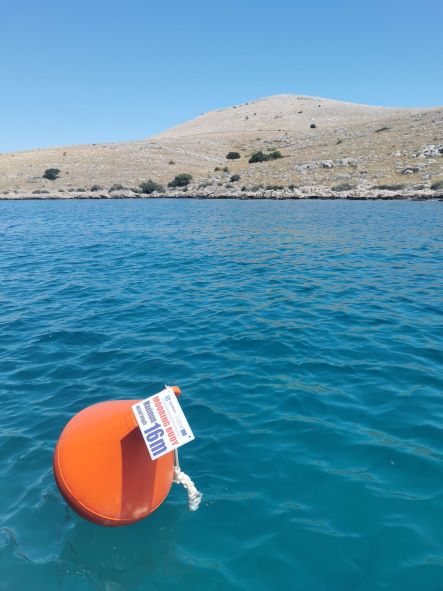
To ensure these issues are finally taken seriously and communicated to both residents and visitors, we have relaunched And where do you anchor? campaign this year as well. Our goal is to extend the campaign to decision-makers because, as Pavičić said: “Change begins in the NGO sector, but must ultimately end in politics.”
If you have an interesting story, advice, or practice to share, if you know someone who might inspire the protection of the Adriatic, or if you simply want to ask a question, contact us at [email protected].