
Environmental organizations Sunce, Biom, Hyla, and Zelena akcija, with the support of local community representative Marko Cvrlja, have initiated an administrative lawsuit against a Decision issued by the Ministry of Environmental Protection and Green Transition. Before the Administrative Court in Split, the plaintiffs are seeking the annulment of the Ministry’s Decision declaring the proposed “Gala – Obrovac Sinjski” solar power plant acceptable in terms of its environmental impact and its effects on the Natura 2000 ecological network.
“The plaintiffs challenge the Ministry’s Decision because it was based on an Environmental Impact Assessment (EIA) Study that is neither comprehensive nor professionally prepared. Numerous well-founded deficiencies clearly indicate that the Ministry should have rejected the investor’s application as early as February 2024. Since this did not happen, citizens were forced to protect their right to a healthy environment through judicial proceedings,” emphasized attorney Ivana Krstulović, who represents the organizations.
What is controversial about the “Gala – Obrovac Sinjski” solar power plant project?
The project, proposed by a company owned by an Israeli energy corporation, envisages the construction of a solar power plant covering 248.5 hectares of porous karst plateau, located only 1.5 km above the Kosinac water intake. This water source is the primary source of drinking water for approximately 30,000 residents of the Cetina region.
The Environmental Impact Assessment inadequately addresses the project’s effects on protected species—particularly strictly protected plant species, target bird species, and invertebrates—and completely fails to assess its impact on caves and other speleological features, as well as on groundwater bodies.

The project is in direct conflict with the provisions of the European Union Water Framework Directive, which requires the application of the precautionary principle and prohibits any activity that could, even potentially, lead to the deterioration of the status of water bodies, especially drinking water sources.
“The assessment of impacts on water resources remains insufficient, particularly given the proximity of the Kosinac water intake. In karst areas, where groundwater is directly connected to surface activities, any shortcomings in the assessment pose a significant risk to the quality and safety of drinking water.”
The study also contains numerous outdated and incomplete data, creating the impression that its purpose was to conceal the actual situation on the ground. Beyond the environmental risks, the project directly threatens the livelihoods of the residents of Obrovac Sinjski, whose lives depend on agriculture, water resources, and livestock farming.
“Regarding fauna, it is important to stress that not a single field survey day was dedicated to collecting data on strictly protected and target invertebrate species, despite the fact that data for this area are already scarce. We consider it absolutely unacceptable to draw conclusions about the project’s impacts without first establishing baseline field conditions,” said Dr. Ivona Burić, Senior expert associate at the Hyla association.
“In addition, the project area contains strictly protected and endemic species, as well as speleological features protected by law. We would particularly highlight the Adriatic iris, a stenoendemic species. Given that the planned project is located in the immediate vicinity of Dinara Nature Park, it is reasonable to expect that other strictly protected plant species are also present in the area,” said Lora Rajić, policy and advocacy officer at the Biom association.
Environmental organizations file lawsuit against the Ministry: the voice of the local community and experts must be respected
Despite these concerns, the Ministry concluded that the project would be environmentally acceptable provided that mitigation measures are implemented.
“Given the Ministry’s Decision, filing a lawsuit to annul it is the only remaining legal remedy. We believe that mitigation measures cannot serve as a substitute for a thorough, accurate, and scientifically grounded assessment of existing conditions. If the underlying expert study does not accurately reflect the actual state of the environment, then the Decision approving the project cannot be lawful. We insist on high-quality, independent Environmental Impact Assessment studies,” explained Eva Šore, legal expert at Sunce.
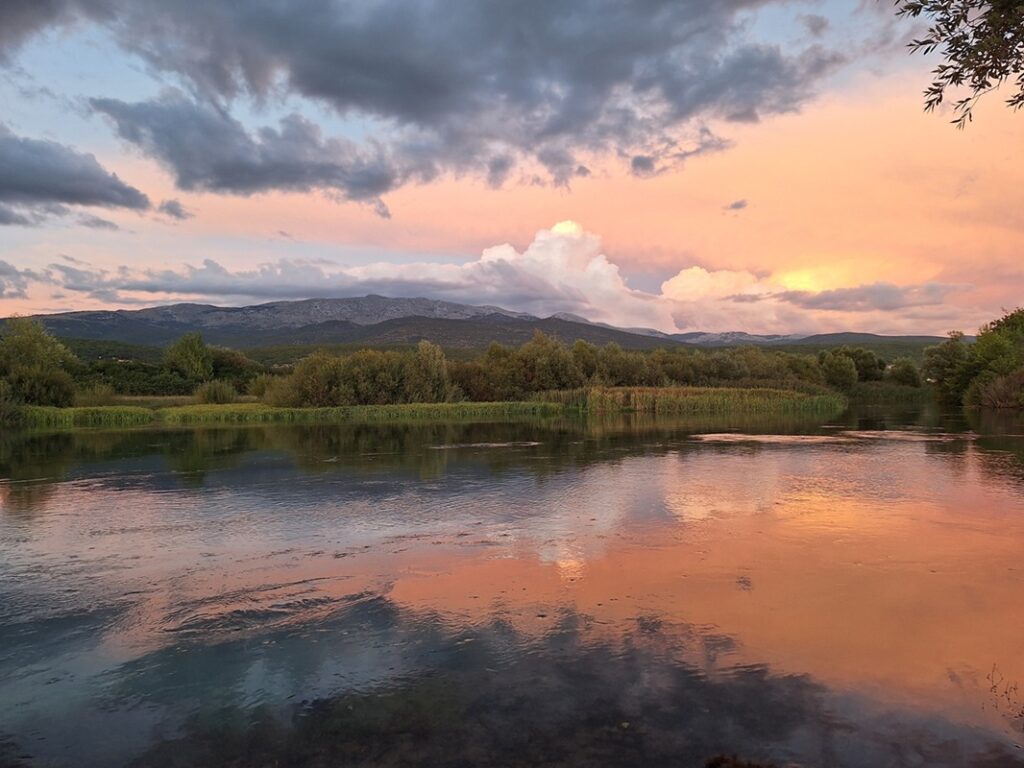
Instead of protecting the public interest and natural values, the Ministry issued a decision that opens the door to irreversible interventions in the environment.
“This project clearly demonstrates that the rights of citizens and local communities to participate in decisions affecting their living environment must be respected. Your voice, your arguments, and your comments must not be overridden by private interests and profit. We support the development of renewable energy sources, but we oppose corrupt decision-making processes, the occupation of valuable agricultural land, and projects that serve only private profit at the expense of the public interest,” stated Enes Ćerimagić, lawyer and vice president of Zelena akcija.
All citizens have the right to participate in decisions about the future of their environment. From the outset, the local community and environmental organizations actively participated in the procedure, submitted expert comments, conducted field research, and clearly expressed their opposition based on the poor quality and unreliability of the Environmental Impact Assessment. Ignoring these concerns is neither acceptable nor lawful.
By filing this lawsuit, the legality of the Ministry’s Decision will now be reviewed by the Administrative Court in Split.
“Through these proceedings, the plaintiffs seek judicial review of the legality of the Decision and the protection of the natural values of the Dinara area, the water resources of the Cetina region, and the rights of the local community and the public to have decisions affecting their environment based on fully established facts and sound scientific expertise. The plaintiffs’ objective is for the Court to annul the Decision and ensure that any future decision on environmental impacts is adopted through a lawful procedure, based on the latest available information and with full respect for the public’s right to participate. I would also remind everyone that environmental damage, once caused, can never be fully reversed. Therefore, we all share responsibility—regardless of our role—to protect the environment and to go the extra mile whenever possible,” concluded attorney Ivana Krstulović.

Funded by the European Union. Views and opinions expressed are, however, those of the author(s) only and do not necessarily reflect those of the European Union or the European Education and Culture Executive Agency (EACEA). Neither the European Union nor EACEA can be held responsible for them.