
In the sea of everyday information, few of us manage to stop, reflect, and learn something meaningful. Yet that is exactly what happened in May 2025, when three inspiring training sessions were held at the Faculty of Chemistry and Technology in Split as part of the Let’s sail through STEM waters – A ticket to 2030 project. Participants, including employees and volunteers from associations as well as staff from educational institutions, immersed themselves in the world of science, ecology, and everyday challenges that require sustainable solutions. And yes, there was grease, water, plastic, and… toilets.
1. Scientific literacy – the power of critical thinking
The first training session, held on 12 May, focused on “Scientific literacy,” a topic that is more important than ever in an age of misinformation. Led by Assistant Professor Ivana Carev, PhD, participants learned how to distinguish science from pseudoscience, identify reliable sources, interpret data, and, most importantly, make informed decisions.


Through a series of practical activities and group discussions, the atmosphere was anything but dry. We are not sure who enjoyed it more, the participants who were learning or the lecturer, who took us out of our everyday routines and straight into scientific thinking.

2. Wastewater – from sewage to awareness
Seven days later, on 19 May, the focus shifted to something most of us would rather not think about: wastewater. The training session, “Wastewater – how it shapes our water world,” was led by Professor Nediljka Vukojević Medvidović, PhD. The topic covered everything from the natural water cycle and wastewater treatment to… our personal water footprint.

It may sound abstract, but it was anything but. Participants calculated how much water they use directly (showering, cooking) and indirectly (through the production of clothing, food, and electronics). They also discovered some surprising facts: that a single cup of coffee “consumes” more than 100 litres of water, and that every toilet flush uses litres of drinking water. It is no surprise that innovative solutions such as rainwater harvesting and the popular concept of “reinventing the WC” were also discussed.

Although the topic was serious, the approach was engaging and visually rich, and participants left with more knowledge, and a little more environmental awareness.
3. Marine pollution – from plastic to responsibility
The third training session, held on 26 May, focused on one of today’s most pressing issues: “Marine Pollution.” Led by Assistant Professor Maša Buljac, PhD, participants explored the causes, consequences, and possible solutions for protecting the marine environment, from microplastics and chemicals to wastewater and oil spills.
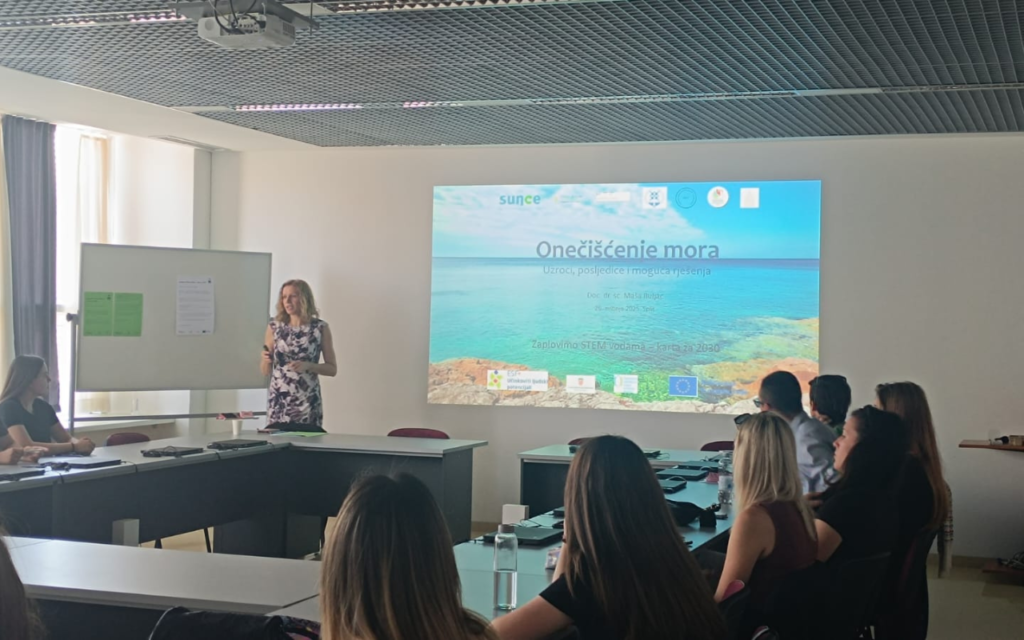
The workshop went beyond simply listing problems. Through interactive activities, participants mapped the pathways of waste from our homes, streets, and sewage systems all the way to the coast and the seabed. They developed their own solution proposals and reflected on how small everyday decisions, such as avoiding single-use plastics can have a significant cumulative impact.

We concluded that what we throw away “somewhere else” often ends up exactly where we least want it: on our plates through fish, in our lungs through sea air, or in the environmental problems we will face in the future.

By scanning the QR code, you can access the workshop registration form. Complete the application, and our team will contact you with additional information.
STEM Is Not Just for Scientists
Three workshops. Three topics. Dozens of participants. One shared goal: to develop scientific thinking and protect nature because we do not have a backup planet. While we wait for the next training sessions, we can check our own water footprint, evaluate our sources of information more carefully, and avoid throwing plastic bottles into the sea. Because STEM starts with us.
The Let’s Sail Through STEM Waters – A Ticket to 2030 project aims to make STEM accessible to everyone: from teachers to volunteers, from students to activists. Because science does not exist only in laboratories, but also in every glass of water, every piece of waste, and every decision we make.

The project is led by the Association for Nature, Environment and Sustainable Development Sunce, Split. The project partners are: the “Krka” Ecological Association Knin, the Faculty of Chemistry and Technology, the Faculty of Humanities and Social Sciences, the Association of Chemical Engineers and Technologists Split, and two primary schools—Domovinske zahvalnosti Primary School and DOBRI Primary School.
The project is implemented with the financial support of the European Union through the European Social Fund Plus (ESF+), under the Effective Human Resources 2021–2027 programme, and is co-financed by the Office for Cooperation with NGOs of the Government of the Republic of Croatia.
Disclaimer: The views expressed in this article are the sole responsibility of the author and do not necessarily reflect the views of the European Union or the Office for Cooperation with NGOs of the Government of the Republic of Croatia.